





































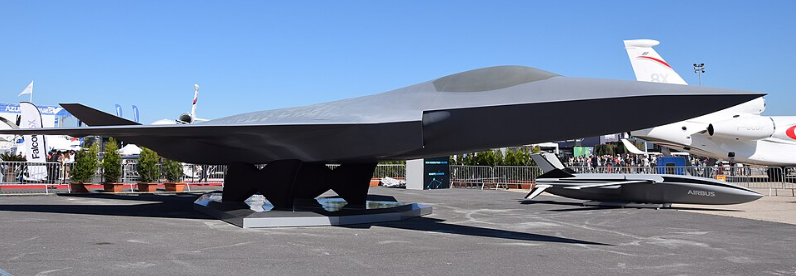
Militaries across the world have been working on sixth generation fighter jets since as early as 2009, only 13 years after the first flight of the F-22, the first ever fifth generation fighter. In all these years of sporadic chatter about a sixth generation, nothing has entered full production, leaving citizens and aviation enthusiasts wondering where they are.
Sixth generation fighters have a very loose definition since they have yet to exist, but some governments have released that they will have better, more durable stealth, further range than its predecessors, AI powered drone wingmen and potentially even laser weapons.
This is in contrast to the fifth generation, whose defining characteristics are any stealth, a high degree of maneuverability and data network integration.
Nations across the world have fifth generation fighter programs, but the main nations that have created them are the US, China and Russia.
China has the J-20 and J-35— both of which look oddly similar to the US’s fifth generation jets— which were released for service entry in 2017 and 2025, respectively. The US had the first ever fifth generation fighter jet, the F-22, which entered service in 2005 and the F-35, which entered service in 2015, both of which were years before any other nation. Russia debatably has the Su-57, with its stealth abilities leaving much to be desired.
It is important to note that the US also has significantly more fifth generation fighters than Russia or China, with estimates ranging around 800 planes for the US and only 400 for China, and Russia squarely in last place with a mere 22.
Another big thing about the fifth generation planes is that they are still at the cutting edge of aviation technology, with many nations still trying to crack the code, including South Korea with the KF-21, Turkey with the TF-X, India with the AMCA and Russia trying to bump up their numbers with the Su-75.
“Russia has barely even fielded a fifth-generation fighter in a functional way—demonstrating the constraints of the Russian industrial base, and the limiting effect of international sanctions. For this reason, even though it has expressed interest in a sixth-generation fighter, it is extremely unlikely that it will be able to produce one at scale for the foreseeable future,” said Harrison Kass, Senior Defense and National Security Writer at The National Interest.
It is obvious, however, that the US and China are pushing closer to the production of the first ever sixth generation fighter jet, especially since China has already tested two of them.
In late December, 2025, China released videos of two different planes in their test flights, claiming that they were both sixth generation fighters. Many people were skeptical of the J-36, claiming that it looked fake and like CGI in its video, but the videos of the J-50 were pretty indisputable.
Skeptics of the J-36 are warranted, as it is known that Russia lied about the abilities of some of their older planes, leading to the production of some of the best planes the US has ever made like the F-15, F-16 and even the F-22. This is to say that it would be totally reasonable to think that the Chinese are lying about the capabilities of their new planes or even making fake videos of them.
In response to these videos, the US decided to announce that they were bumping up the date of the first test flight of their sixth generation program, the F-47, to 2028 from its previous 2029 estimate. This means that with accelerated production, the F-47 could theoretically be in service before the J-36 or J-50, but it is unlikely.
“We have a long history of designing and delivering aircraft that give commanders and warfighters the advantage when the stakes are highest— including the new, 6th-generation F-47 stealth fighter, which will dominate the battlespace for decades to come.” said Boeing, the company tasked with creating the F-47.
A few other nations have sixth generation programs that have yet to schedule test flights, including Russia, Sweden, India, a joint operation between Spain, Germany and France and another joint operation with Japan, Italy and the UK.
Civilians of the world won’t know when sixth generation fighters enter service until it’s announced, but it is safe to say that militaries across the world are working tirelessly to be the first.