












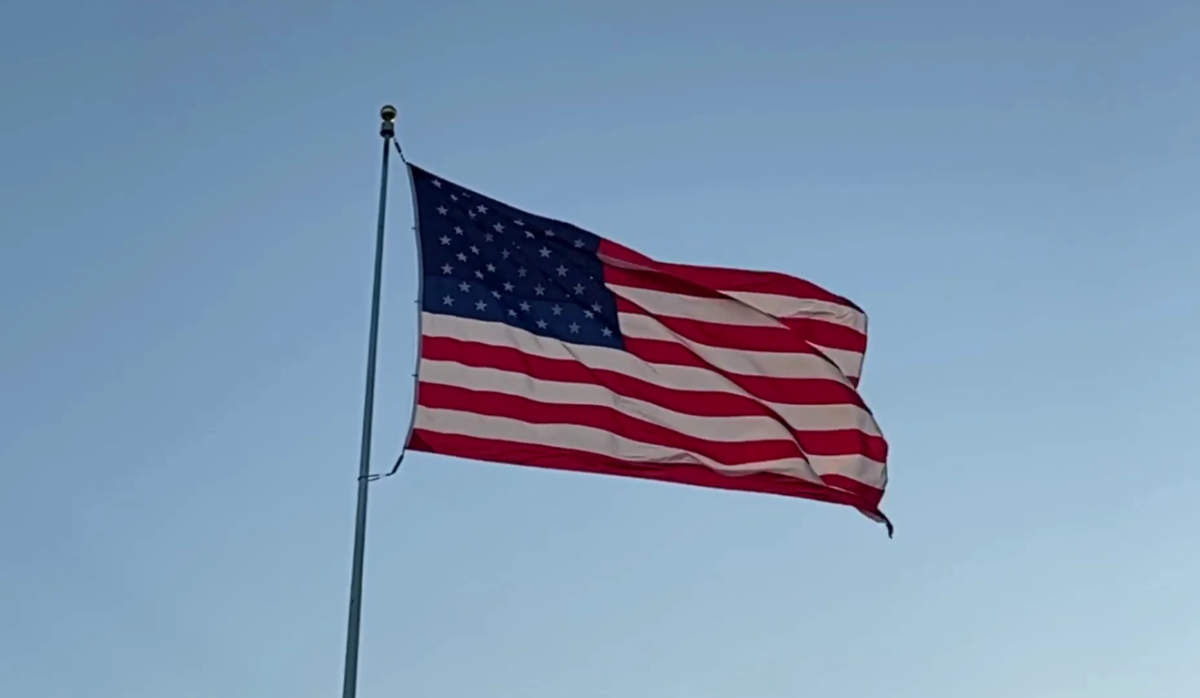







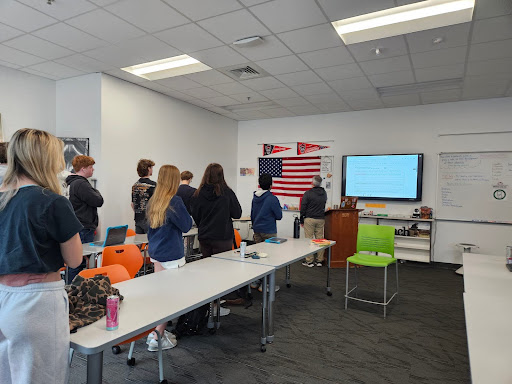
‘Please stand to recite the Pledge of Allegiance’ the announcement system says. Some students slowly stand up. Some don’t look up from their phones. Some stand at attention. We see all different reactions every day at school during the Pledge of Allegiance, but often we don’t know why our classmates make these decisions, or the impact this choice has on them.
Senior Saron Getaneh stands for the pledge and puts her hand over her heart every morning.
“To me, the pledge means a symbol of commemoration for all of our veterans. I feel like standing for the pledge does show respect for what people died for in war, and it just shows respect for our country,” Getaneh said.
Other students such as juniors Paige Alexander and Callie Fillard shared a similar sentiment.
“It’s in honor of all the people that have served for our country, for the people that have fought for our rights and our country in general to make it a better place,” said Fillard. “And my grandpa served in the Marines, so I stand for him, too.”
English teacher Marshall Wortham said that he does stand for the pledge for similar reasons to Getaneh, Alexander and Fillard.
“I just think about all the freedoms we have in this country and the military who fought and died to protect those freedoms,” Wortham said. “I think about my grandfather who went to World War II and left his family to defend his country. Those are the things that always run through my mind every day, and it’s kind of like a daily reminder.”
However, the Pledge of Allegiance doesn’t hold the same meaning to everybody.
Junior Christopher Rodgers and freshman Roman Bradley shared that they do not stand for the pledge.
“I feel like it’s bogus,” Bradley said. “[It’s] like a chore.”
Rodgers went on to share that he felt it was pointless, and both said it meant nothing to them.
Some students, such as sophomore Judah Turner, find themselves standing for it out of force of habit more than any personal meaning. Turner shared that he sees it as a “sentence of words,” and only stands for it because it became second nature after his years in Boy Scouts.
Yet another take is that the Pledge of Allegiance is political and that standing for the pledge is standing for what is currently occurring in our political climate.
Sophomore Lana Briscole said she doesn’t stand for the pledge.
“I believe that this country is corrupt, and I don’t stand for what it believes in anymore,” Briscole stated. “[The pledge] basically means, in my opinion, that you stand for what this country believes.”
Junior Taylor Pearson sees it similarly to Briscole.
“I don’t stand [for the pledge] because I don’t believe in a lot of what America is doing right now. I believe that I love my country, but I don’t think that I’m properly represented right now in what our country is doing,” Pearson said.
Pearson went on to say, “[The pledge] is respect for everyone who’s given their lives to our country, and I respect those people, but I don’t respect our president and what he’s doing.”
The Pledge of Allegiance, an experience almost all children raised in the United States has had, holds vastly different meanings to each person. Some stand to honor the military and those that we have lost in service. Some sit because it holds no meaning to them. Some stand out of habit, and some sit out of defiance.
Whether you sit or stand, whether the pledge means something to you or not, the way we act during the recitation of the Pledge of Allegiance means something to everyone and says something about each person.
No response to the pledge is wrong, so long as you are respectful to those who react differently than you do and aren’t disruptful to whoever chooses to stand. The interesting thing about everybody’s varying responses is the diversity of outlooks that a set of students in the same school with the same general experience hold.