




































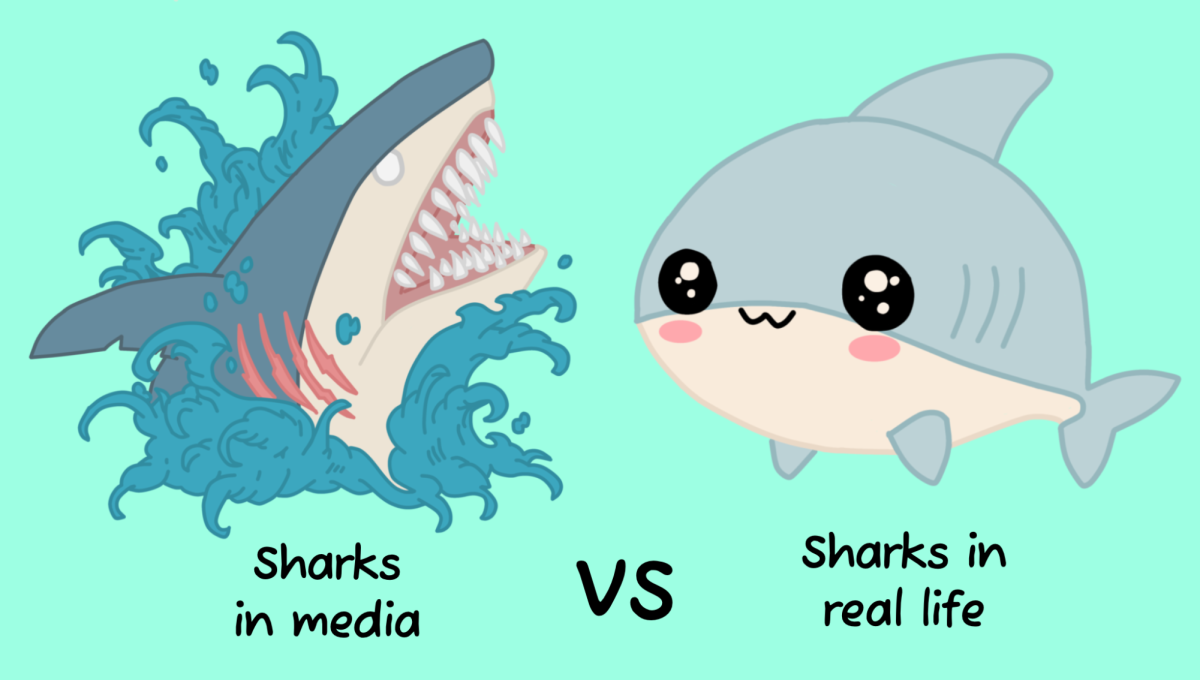
You have probably heard about bear attacks or shark attacks, but are these animals really as dangerous as people think, or do they simply have a bad reputation?
There are many different types of sharks: whale sharks, basking sharks, goblin sharks, and tiger sharks, just to name a few. Many people think that these animals are scary because of their size and how many teeth they have. However, humans aren’t a staple of sharks’ diets; the main reason behind shark attacks is a simple case of misidentification. Underwater, a surfer can look a lot like a seal or turtle, some of the larger species that sharks prey on. Despite their intimidating size, whale sharks don’t even eat large prey animals; their diet consists of krill, crab, fish larvae, small schooling fish, and jellyfish.
Bears are another animal who are known to be dangerous, yet humans are not a natural part of their diets. There is a myth that bears are naturally aggressive towards humans, but this is inherently false. The Interagency Grizzly Bear Committee informs us that bears usually avoid conflict with humans and that most dangerous encounters happen when the bear is surprised, protecting cubs or guarding a large food source. Bears who have been exposed to human food or become accustomed to eating out of the garbage, however, may become dangerous and aggressive towards people. Bears are also omnivores just like humans are.
Many people are scared of spiders, and with good reason; there are so many that can kill with one drop of venom. However, spiders do see humans as a threat and will only bite as a last resort. Humans are so much bigger than spiders, which makes us a threat to them as we can easily kill them with our shoes. Also yes, almost all spiders are venomous, but most don’t have venom potent enough to harm a human.
The Burke Museum says, “Of around 50,000 spider species known, only about 25 have venom capable of causing illness in humans.” That is about 0.05% or 1/2,000 of all spider species.
Snakes behave similarly, as they will not attack humans unless provoked. National Geographic states that there are 3,000 types of snakes, out of which only 600 are venomous, and only 200 can hurt or kill a human.
Many of these animals are feared because they have the ability to kill. However, most of them will not attack unless provoked, and a lot of them actually benefit humans and the environment in significant ways.
Spiders hunt flies and other small bugs like mosquitoes and in doing so they help protect our crops. Spiders eat approximately 600 million tons of insects annually. They are also highly sensitive to habitat changes and pollutants, helping environmentalists monitor an ecosystem to keep it healthy.
Snakes also help protect crops by killing small rodents, which has the additional benefit of preventing the spread of disease. Toxins found in snake venom have also led to breakthrough treatments for things like high blood pressure, heart attacks and blood clots. Additionally, scientists have found that specific proteins found in the venom of certain vipers have shown potential in stopping the growth and spread of breast cancer cells.
Bears help keep forests healthy; they eat plants and help spread seeds to make new trees and they help control deer and elk populations, ensuring a balanced ecosystem.
Deep sea sharks eat dead carcasses at the bottom of the ocean keeping the carbon from reaching the surface. They also hunt sick, weak and old fish, keeping the fish population healthy and strong. This also helps curb overpopulation.
On the other hand, there are animals that are portrayed as harmless in the media and popular culture but are actually quite the opposite. Hippos are one of the deadliest and most aggressive large land mammals in the world. They are very territorial and are responsible for 500 to 3,000 human fatalities every year in Africa. In a similar vein, dolphins are apex predators who have caused severe injuries like broken bones, lacerations and bites in humans and other sea creatures. They have also been known to drown humans.
Kangaroos will attack humans if threatened but have been known to kick and even drown humans unprovoked. One of the largest animal contributors to human injury can be found in homes across the globe: dogs. Every year there are anywhere from 4.5 to 4.7 million dog bites, one in five bites requiring medical help, and 30–50 deaths occur annually. The good news is that most dogs won’t attack unprovoked.
You should never judge a book by its cover. Something may look dangerous but can be completely harmless, and something could look all cute and cuddly but you shouldn’t touch it. This doesn’t mean you should go up to bears and sharks to try to pet them, as they still have the ability to kill. This also doesn’t mean you should be afraid of dogs or dolphins. If you see someone walking their dog, always ask before you pet it, and if it’s a stray, it’s better not to approach them.