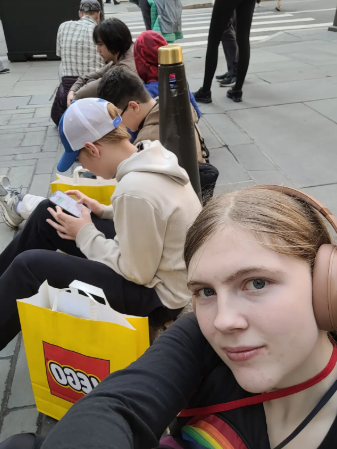
Almost every teen and adult has a phone. These devices make it easier to contact people, look things up and even meet new people. But have phones really made us connected or are they slowly isolating us?
We have the power to message someone half way across the world and get an answer in seconds right in our back pocket. I had a friend who lived all the way in California who I could talk to in seconds because of my phone; they’ve made it so easy to talk to people.
What is the problem then? Well, it’s that people aren’t talking in person as much anymore. Some of that is due to the effects of the pandemic, but that’s not the only reason. Kids will be sitting right next to each other and not even talk because they are on their phones. I too am guilty of this, sitting with family at dinner and being on my phone playing games.
Talking on online platforms may seem like you’re making connections, but there’s often little meaning behind these interactions. Most times the conversations don’t extend beyond a like or an ‘lol.’ At first these platforms were nice, but they’ve become shallow to the point where you see the same response over and over.
It is also very easy to see into someone else’s life when you’re scrolling through their social media. Every time they go on a fun trip or make an expensive purchase, their followers are the first to know about it. This can cause people to feel worse about their life because social media glamorizes everything. People are becoming more lonely and feeling more left out.
Online spaces have also made people not want to leave the house as much. Sharing photos on the internet seems like an everyday thing, but knocking on a friend’s door seems like an impossible task.
A study by Stevenson University came to the conclusion that time spent with friends in person has dropped by 20 hours per month since 2003, and the number of people living alone has doubled since 1960. Loneliness among Gen Z has risen higher and higher whereas happiness is in a downward trend.
“In the past, happiness across the adult lifespan took on a U-shaped curve. Young adults were among the most content with their lives, happiness dipped in middle age and then rose again among older adults. In recent years, this decades-old curve has shifted into a straight, upward line. Older adults remain happy, and middle age remains middling, but young adults are now less happy than either group,” said writer Melissa De Witte from Stanford Report.
Gen Z is the most connected yet at the same time the most disconnected generation. We as humans have started losing that in-person connections, and the introduction of phones and other technology has accelerated this trend.