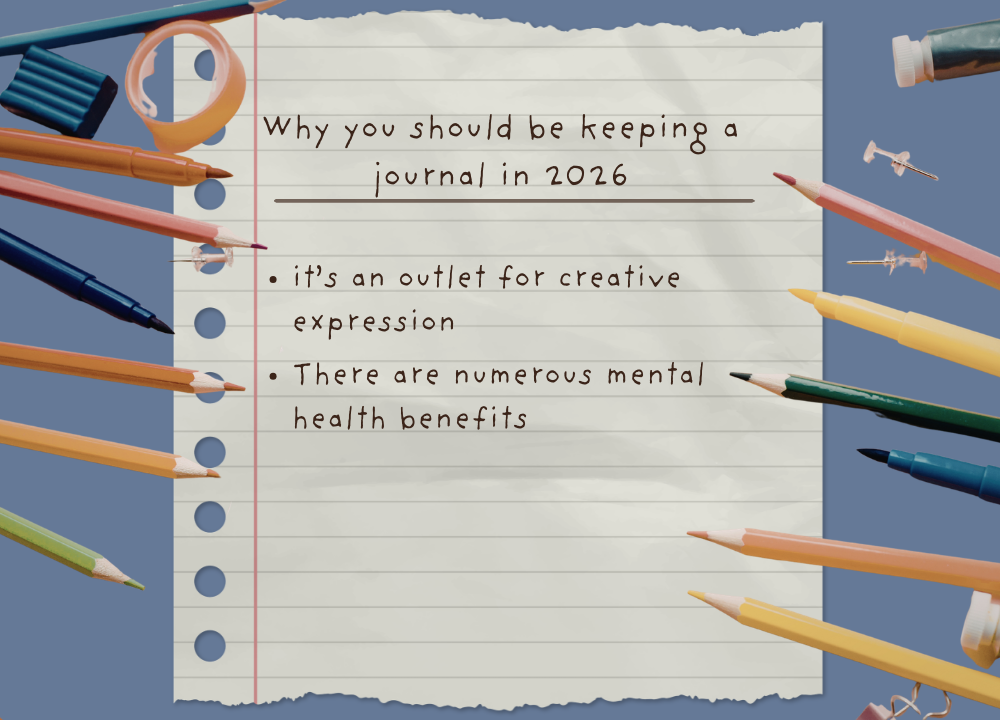
Have you ever felt so overwhelmed that you didn’t know what to do with yourself? Ever had a secret so personal that you didn’t want anyone to know but still wanted to express it in some way? Have you ever just wanted a book that you could doodle in and stick pictures into? Well, the answer may lie in a stack of paper bound together with dreams, emotions and probably too much tape: you should try keeping a journal.
For those unaware, the month of May is designated as ‘Mental Health Awareness Month.’ This is a time to reflect on how we think and treat ourselves and our emotions. Just as we have to take care of our physical hygiene, we should be conscious of our mental hygiene as well. Whether that be through meditating, being kinder and more forgiving of our faults or accepting ourselves for who we are, now is the time to take charge of our mental health, and keeping a journal is a great place to start.
Journaling is proven to help improve individuals’ mental health, and not only when they feel sad or upset. Having the ability to write down what you’re feeling at any given moment can help you self-regulate and feel more in touch with your emotions, especially if you struggle with being open with others. Talking with family and friends can be beneficial as well, but learning your own emotions and thought patterns can be incredibly helpful for maintaining relationships and navigating your mental health.
According to the University of Rochester Medicine, “[Journaling is] simply writing down your thoughts and feelings to understand them more clearly. It can help you gain control of your emotions and improve your mental health.”
From a psychological perspective, journaling helps reduce anxiety and promote self-reflection through repetitive, structured daily entries. Additionally, you have the ability to look back on previous entries, which can serve as markers for self-growth as you progress through your own mental health journey.
As licensed counselor David Wood explained, “Journaling is very helpful for cognitive anxiety as well as existential stress. We think much faster than we write, so writing helps to slow our thinking, follow trains of thought to their rational conclusions, and the general catharsis of seeing an irrational thought in the physical form of ink and paper can be very helpful and alleviating.”
Journaling can also be a great way to express your creative side. While the word ‘journal’ itself may bring to mind images of leather-bound books and smudged ink marks, there is no limit to what constitutes a journal. A scrapbook, a sketchbook, an online moodboard, all of these can be interpreted as journals because they contain bits and pieces of a person’s life, whether that be their interests, emotions or their cherished memories.
All in all, whether you’re looking to improve the state of your mental health, express yourself creatively or you’re simply seeking an outlet for big emotions, keeping a journal just might be the answer you’re looking for.